

I am a Gaming Industry CTO, 20+ year technologist, and recovering attorney building the agent tooling this site runs on. I wrote the Caddyshack themed nine-layer AI governance framework the project implements, sets the policy the agent publishes under, and publishes every override he makes with its reason.
The main goal is for this project is to see how close we can dial in the "truth" of the content in an open, public forum. There is so much noise around "agents" - this is designed to be concrete and tangible.
Regulators, attorneys, technologists -- get some clarity on how this AI governance tooling stuff works if you're not exposed to this on a daily basis.
We're all going to learn something from this! If you happen to be an expert in any of these layers, feel free to reach out!
 Read the framework this project implements — AI Governance, the Gopher, and Earth's Infrastructure ↗
The most interesting unsettled question in U.S. gaming law
A federally licensed exchange sells contracts on who wins Sunday's game. Forty-one state attorneys general told the CFTC that's a bet. Congress never said which one is right.
One court of appeals has answered on the merits, and one district court has entered final judgment the other way. Everything else is preliminary — dozens of orders, moving most weeks, in opposite directions, with the Supreme Court not yet asked.
- The answer depends on the courthouse. One appellate ruling says preempted; Utah, New York, Wisconsin, Ohio, Maryland, Massachusetts, Washington and Nevada say otherwise.
- It changes most weeks. Eighteen states have active legal proceedings as of 9 August 2026 — with new court orders entering most weeks.
- Nobody publishes the compliance answer with the order behind it. The trade press reports the headline; the dockets sit behind PACER.
An agent you can actually audit — built by a CTO who is also a lawyer
Anyone can claim their AI is trustworthy. This one publishes the work: the dashboard is open, and so is the repo.
A domain where a wrong citation has consequences is the honest test. The agent researches and publishes on its own — and everything it decided along the way is readable by anyone, without a login.
- How each decision was made. Sources read, leads rejected and the reasoning at every step — on the public ops. dashboard.
- Where a human intervened. Every override and its reason, published — so you can judge how often, and about what.
- Whether the citations hold up. Every claim links to a Tier-1 source; trade press is a lead, never the citation of record.
- Open source, end to end. The pipeline, the prompts and the surfaces are in the repo — fork it, or check the work.
Open source. Visible pipeline. Citations first.
Trust is a product feature — not a marketing claim. If you cannot see how a finding got made, it does not belong here.
- Open source
- Code, methodology and the governance record are public. Fork it, critique it, build on it.
- Citations
- Citations are first-class. Tier-1 primary sources are required; unverified claims do not ship.
- Trust rating
- Each published article exposes how it was produced: model path, confidence posture, gate decision and the evidence packet on ops.
- Reuse
- Anyone can use this however they want. Transparency is the point.
We're building the layers in public
Core. Mantle. Crust. Fault lines. A series — not an overnight launch.
Trustworthy agents are not a single product drop. They are an AI control plane — inference at the core, real-time policy in the mantle, evidence and GRC in the crust — with fault lines where systems usually fail silently.
I wrote that framing here: AI Governance, the Gopher, and Fault Lines.
PML is the progressive build of those layers against a real legal domain. Expect LinkedIn posts and the ops. journal as each layer ships.
An open source of record for prediction-market litigation.
Right now the answer to “is this legal here?” depends on which courthouse you ask, and nobody publishes it with the order behind it. This project does — and shows its work.
Every U.S. matter where a CFTC-licensed prediction market meets state gambling law: the posture of each state, the controlling case, the issues in dispute, and a primary source for every claim. Maintained by an autonomous agent pipeline that may research, draft, propose, and publish to the website. The critical factor is showing the trust and reliability of the publish, and that's what the ops and transparency part of the project is here to do.
Several ways to read the same record
These will be the features of the website once it gets going
Everything below is the outcome this platform is being built to deliver. It has not been through the governance process. This is the first dry run of the earliest agents — sourcing the material and reviewing it, with no policy enforcement, no evaluation gates and no publish controls applied. Treat it as a demonstration of the shape of the output, not as a verified record.
Open the tracker to see a demo in action!
Every matter, one record
Caption, court, docket number, posture and a written digest of what the court actually held — with the docket beneath it, most recent first, each entry linked to its primary source.
Which theories win, and where
Each matter tagged to an issue vocabulary — preemption, swap definition, state gaming acts, tribal and consumer theories — then counted by outcome, so you can see what is pleaded everywhere and what actually loses.
When each issue entered the record
One mark per matter at its first docket event, coloured by posture today — the arrival order of the arguments, which is how you spot a theory spreading between circuits.
Posture by state and circuit
The controlling answer in each state, the circuit it sits under, and what is untracked — shown as a map and as a sortable board with the controlling case named.
Who is actually bound
The record re-cut by party — exchange, regulator, tribe, state — because an order binds an entity, not a market. Read it the way an injunction reads.
What would take this to the Court
The split as it stands, the deadlines on file, and the conditions that would make review likely — tracked as the docket moves rather than asserted once.
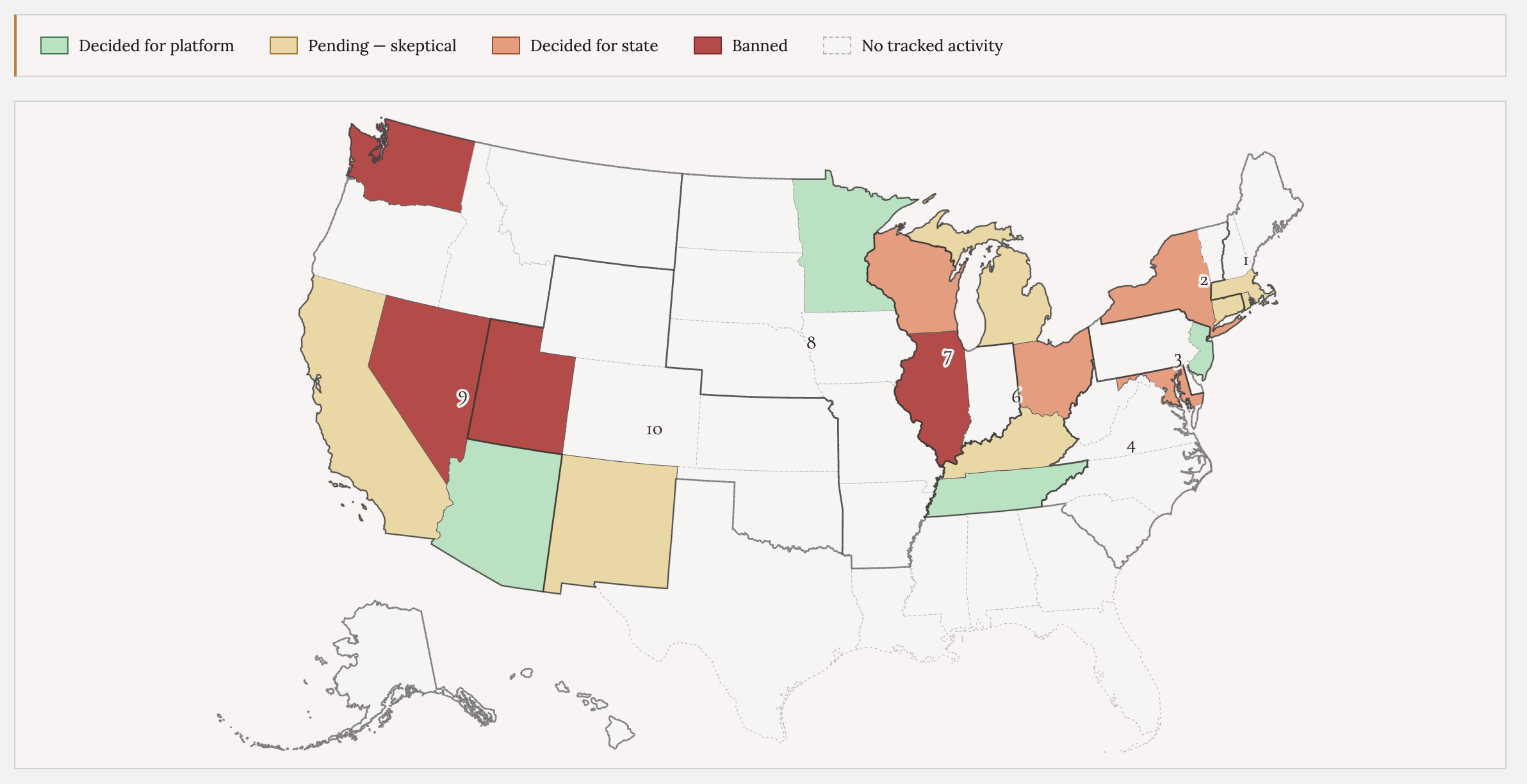
Real state topology, real posture data, circuit boundaries drawn over. Untracked states are dashed — absence of a finding is not a finding of legality.
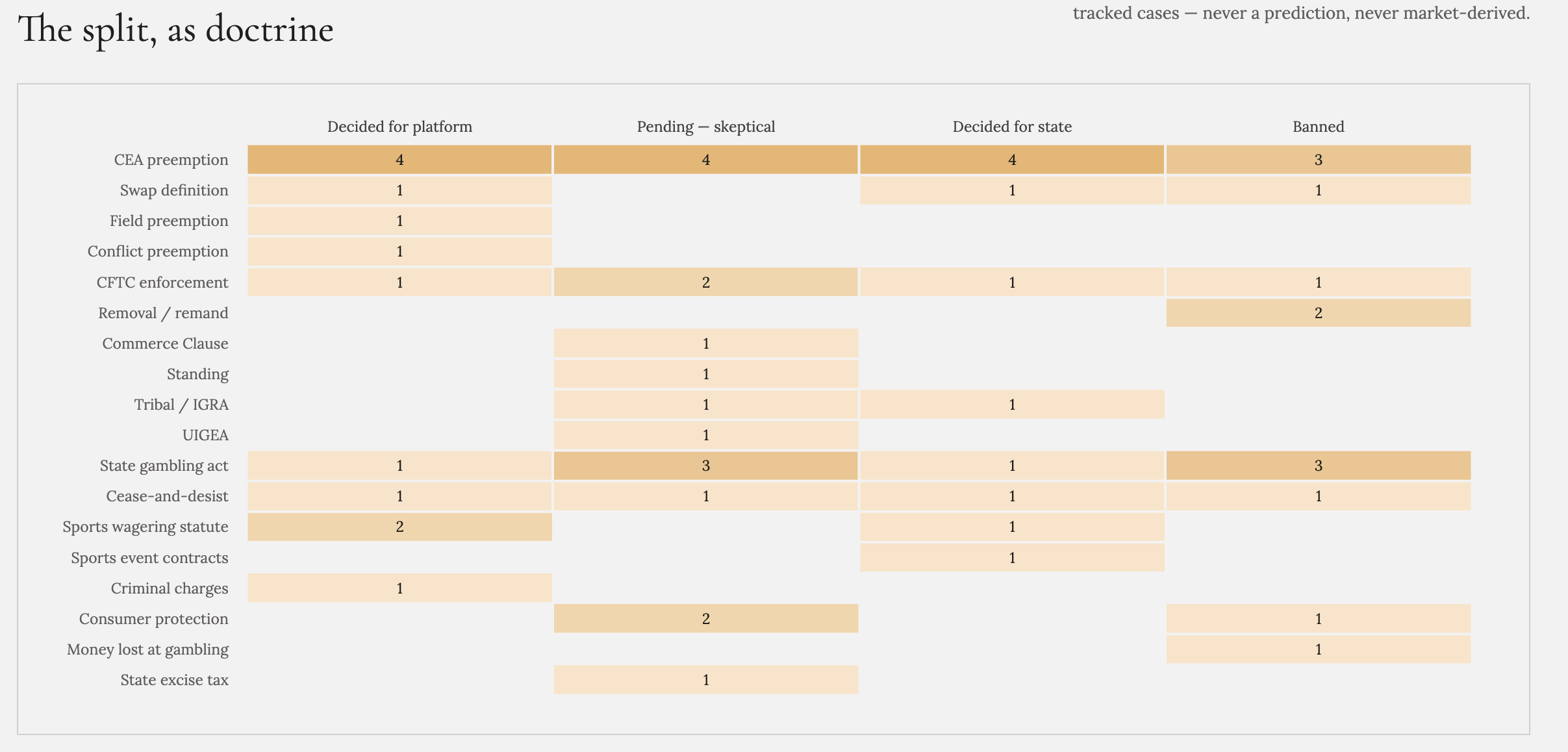
Eighteen issue tags across nineteen matters. Counts of tracked cases — never a prediction, never market-derived.
The litigation is the subject; the governance is the message
Built on the nine-layer model Patrick published — governance read as the layers of the Earth, with the fault lines at the seams.
Every source fetched, with its tier.
Leads dropped, and the reason each was dropped.
Which evals ran, what they returned — or “not run”, said plainly.
Model, prompt version and cost, step by step.
Before and after, word for word, on the live record.
3 · Guardrails — injection, PII, output validation.
4 · Action policy — what the agent may publish is enumerated, and enforced.
5 · Orchestration — steps, retries, and the reasoning recorded at each one.
6 · Identity & scoped access — agents as first-class identities.
8 · Lineage & provenance — source to output, frozen at publish.
9 · GRC — mode, thresholds and overrides, audited in public.
Earthquakes happen at boundaries, not inside layers. Every handoff is a seam — so this project instruments them and publishes what it sees. Read the framework ↗
The agent publishes on its own. Every run ships with the reasoning behind it: what it read, what it rejected and why, which checks ran and what they scored, what it spent, and a full before/after diff — including the runs that changed nothing. Anything a human overrides is published too, with the reason.
Open ops. ↗Corrections open a public GitHub issue and enter the pipeline as evidence. You can follow the run that answers it — including the reasoning that accepted or rejected your point. Anonymous filing supported.
The published record you can browse today came out of an ungoverned dry run: sourcing and review only, no policy enforcement or publish controls. The governance layers described above are what it is being moved onto next — and every step of that move will be published too.